Story • Definition • Quran • Hadith • Islamic Scholars • World Religions • How to Develop Honesty • Rewards in Society and State
📖 Part One — A Heart-Touching Story
“A Coin and an Empire”
Many years ago, in the bustling markets of Baghdad, there lived a young blacksmith named Yunus.
Yunus was poor, but his craftsmanship was exceptional. The iron tools he forged were considered among the finest in the city.
One day, a wealthy merchant came to his workshop.
“I need a special lock,” the merchant said. “Name your price. But I need it by tomorrow morning.”
Yunus worked through the entire night.
By dawn, the lock was finished.
But there was a problem.
A tiny defect remained inside the lock—so small that no ordinary customer would ever notice it. Only a skilled expert could detect it.
At first, Yunus thought:
“The merchant is wealthy. He will never discover this flaw. I can simply take the payment.”
But then another voice echoed in his heart.
It was his father’s advice:
“Yunus, even when people do not see, Allah sees.”
Without hesitation, he melted the lock and started over.
Before sunrise, a perfect lock was ready.
The merchant returned and examined it carefully.
“How long did it take you?” he asked.
“All night,” Yunus replied.
The merchant smiled.
“I know. I stood outside your shop and watched. You rebuilt it even though nobody was watching.”
Yunus froze in surprise.
The merchant continued:
“I never came here looking for a lock. I came looking for an honest man. I own a large factory in another city, and I need someone trustworthy to manage it.”
That single decision—
That one honest moment—
Changed Yunus’s entire life.
Within ten years, he became one of the most respected businessmen in the region.
Yet people did not remember him as the finest blacksmith.
They remembered him as Al-Amin—the Trustworthy.
“Even when nobody is watching, Allah is watching. Honesty is tested most when no one can see you.”
📚 Part Two — What Is Honesty?
2.1 Linguistic and Technical Meaning
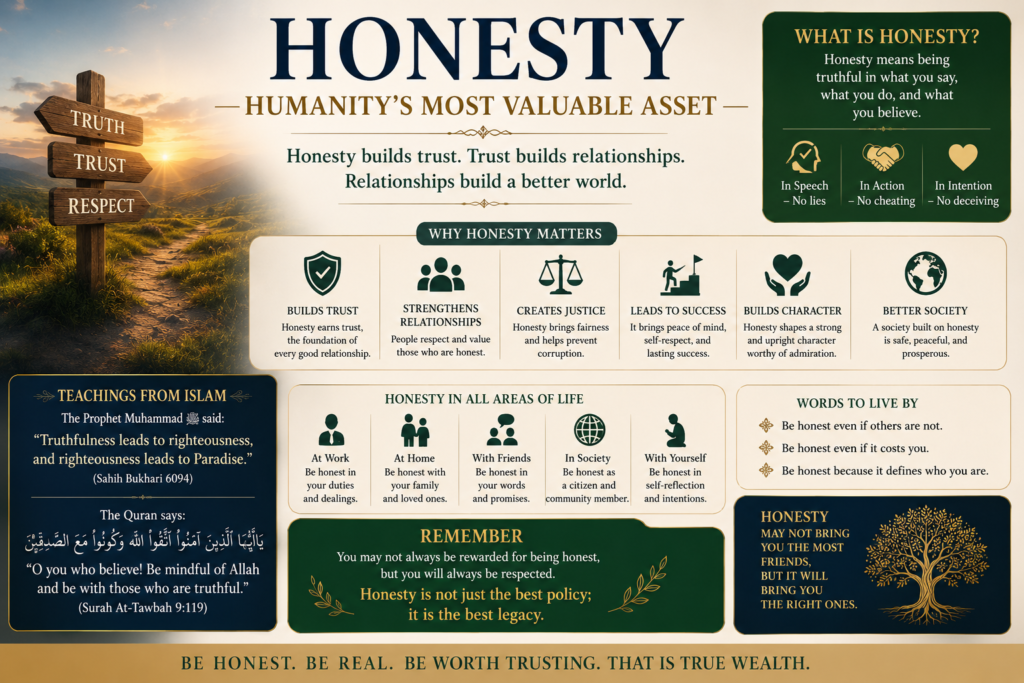
The English word honesty refers to truthfulness, integrity, and sincerity.
In Arabic, two important concepts are associated with honesty:
Arabic
Transliteration
Meaning
صِدْق
Sidq
Truthfulness in speech, action, and intention
أَمَانَة
Amanah
Trustworthiness and responsibility
2.2 Islamic Definition
Islamic scholars explain that Sidq (honesty) is not limited to telling the truth with one’s tongue.
True honesty includes:
Truthfulness in speech
Sincerity in actions
Purity of intention
Fulfilling responsibilities
Keeping promises
Acting with fairness and integrity
Simple Definition
Honesty is when what is in your heart, what comes from your tongue, and what appears in your actions are all aligned.
When these three become one, complete honesty is achieved.
2.3 The Three Levels of Honesty
Level 1 — Honesty in Speech
Avoiding lies
Avoiding exaggeration
Speaking truthfully
Level 2 — Honesty in Actions
Doing what you say
Protecting trusts
Fulfilling commitments
Level 3 — Honesty in Intention
Being sincere for Allah alone
Avoiding hypocrisy and showing off
Aligning inner reality with outward behavior
📖 Part Three — Honesty in the Quran
3.1 Surah At-Tawbah (9:119)
“O believers! Fear Allah and be with those who are truthful.”
Lesson
Allah commands believers not only to be truthful but also to surround themselves with truthful people, because good company strengthens character.
3.2 Surah Al-Ma’idah (5:119)
“This is the Day when the truthful will benefit from their truthfulness. For them are gardens beneath which rivers flow, where they will remain forever. Allah is pleased with them, and they are pleased with Him. That is the supreme success.”
Lesson
On the Day of Judgment, when excuses fail, honesty will become a person’s greatest asset.
3.3 Surah Al-Baqarah (2:42)
“Do not mix truth with falsehood or conceal the truth knowingly.”
Lesson
Half-truths and deliberate concealment are forms of dishonesty.
3.4 Surah Al-Ahzab (33:70)
“O believers! Fear Allah and speak words that are right.”
Lesson
Truthful speech is a command from Allah.
📜 Part Four — Honesty in the Hadith
4.1 The Famous Hadith on Truthfulness
The Prophet ﷺ said:
“Truthfulness leads to righteousness, and righteousness leads to Paradise. A man continues to speak the truth until he is recorded with Allah as a truthful person.”
(Sahih al-Bukhari 6094)
4.2 Honesty in Business
The Prophet ﷺ said:
“If the buyer and seller are truthful and disclose defects, their transaction will be blessed.”
(Sahih al-Bukhari 2079)
4.3 Honesty and Hypocrisy
The Prophet ﷺ said:
“The signs of a hypocrite are three: when he speaks, he lies; when he promises, he breaks it; and when entrusted, he betrays the trust.”
(Sahih al-Bukhari 33)
4.4 Speak the Truth Even When It Hurts
Ali ibn Abi Talib (RA) said:
“Hold firmly to the truth, even if you fear it may harm you. It is better than a lie that appears beneficial.”
4.5 Honest Traders
The Prophet ﷺ said:
“The truthful and trustworthy merchant will be with the Prophets, the truthful, and the martyrs.”
(Tirmidhi 1209)
🌟 Part Five — Wisdom of Great Islamic Figures
Prophet Muhammad ﷺ
Before Prophethood, the Prophet ﷺ was known as:
Al-Amin (The Trustworthy)
As-Sadiq (The Truthful)
Even his enemies acknowledged his honesty.
Abu Bakr As-Siddiq (RA)
He was given the title As-Siddiq because of his unwavering commitment to truth.
He said:
“Truthfulness is the foundation of faith, while falsehood is the foundation of hypocrisy.”
Umar ibn Al-Khattab (RA)
He once told a dishonest merchant:
“Whoever cannot trade honestly has no place in our marketplace.”
He also said:
“Whoever does not fear Allah in private does not truly fear Him in public.”
Imam Al-Ghazali (RA)
He described five dimensions of honesty:
Honesty in speech
Honesty in intention
Honesty in determination
Honesty in action
Honesty in faith and religion
He said:
“The truly truthful person is one who is unaffected by people’s praise or criticism.”
Imam Al-Shafi‘i (RA)
“A truthful person may have one enemy and still succeed. A liar may have a thousand friends and still fail.”
Rabia Al-Adawiyyah (RA)
When asked how she loved Allah so deeply, she replied:
“I have never hidden anything from Him. What love is greater than honesty?”
🌍 Part Six — Honesty in World Religions
Christianity
Jesus taught:
“Let your ‘Yes’ be yes, and your ‘No,’ no.”
(Matthew 5:37)
Truthfulness should be so strong that oaths become unnecessary.
Buddhism
Honesty is part of Right Speech in the Noble Eightfold Path.
It includes:
Speaking truthfully
Avoiding deception
Communicating with compassion
Hinduism
Honesty is known as Satya and is one of the core moral principles.
A famous teaching states:
“Truth alone triumphs.”
Judaism
The Hebrew concept Emet represents truth and sincerity.
The Talmud teaches:
“The seal of God is truth.”
Universal Lesson
Every major religion agrees on one principle:
Honesty is among the highest virtues of humanity.
🌱 Part Seven — How to Develop Honesty
1. Be Honest With Yourself
Self-honesty is the foundation of all honesty.
Reflect daily:
“Did I lie today? Did I violate someone’s rights?”
2. Remember Allah Is Watching
Develop awareness that Allah sees every action.
“Indeed, Allah is Ever Watchful over you.”
(Quran 4:1)
3. Avoid Small Lies
Small lies often open the door to bigger lies.
Challenge yourself:
Go one week without telling a single lie.
4. Keep Honest Company
The Prophet ﷺ taught that people are influenced by their companions.
Surround yourself with truthful people.
5. Develop Courage
Sometimes honesty is difficult because truth may carry consequences.
Ali (RA) said:
“Speak the truth even if it is against yourself.”
6. Promise Less, Deliver More
Honesty includes fulfilling commitments.
“Fulfill every commitment. Indeed, commitments will be questioned.”
 No Comments